![HM Logo[words].jpg](https://static.wixstatic.com/media/f6e04a_f429f6c8934d4e4c9e79fcf44a95a0ff~mv2.jpg/v1/crop/x_15,y_114,w_628,h_360/fill/w_118,h_60,al_c,q_80,usm_0.66_1.00_0.01,enc_avif,quality_auto/HM%20Logo%5Bwords%5D.jpg)
FURTHER RESEARCH - INFLAMMATION
Naquinate suppresses inflammation in vascular smooth muscle cells.

In collaboration with the Royal Veterinary College and University College London, the Haoma scientific team has published new pre-clinical evidence that Naquinate exerts a powerful anti-inflammatory effect on human vascular smooth muscle cells — a key driver of vascular calcification, atherosclerosis and arterial stiffening with age.
The mechanism opens a credible second therapeutic axis for Naquinate beyond bone, in a vascular calcification market with high unmet need and limited disease-modifying options.
FURTHER RESEARCH - ARTERIAL CALCIFICATION

Reducing arterial calcification.
Arterial calcification is a major driver of cardiovascular ageing — stiffening vessels and raising blood pressure. Nq8 acts on the vascular smooth muscle cells (VSMCs) that orchestrate this process, reducing IL-6 release and slowing calcium deposition.
01 VSMC IL-6 release reduced — the cytokine driving the osteogenic switch in vessels.
02 Calcium deposition in vascular tissue is suppressed.
03 Vessel elasticity preserved — supporting healthier blood pressure with age.
04 Mechanism shared with bone — the same anti-inflammatory action protects two systems at once.
CALCIUM DEPOSITION - ARTERIAL CROSS SECTIONS
Less minerals laid down in vessels — dose-dependently
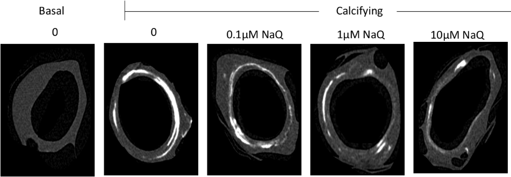
Micro-CT cross-sections show progressively less white calcium deposition in the arterial wall as Nq8 concentration rises from 0 to 10 µM under calcifying conditions.
FURTHER RESEARCH - ANTI-INFLAMMATORY EFFECTS
A naturally-occurring
anti-inflammatory metabolite that declines with age.
Nq8 acts as a potent anti-inflammatory agent, targeting cytokines such as Interleukin-6 (IL-6) and TNF-α. With age, reduced Vitamin K availability limits Nq8 production, impacting multiple organ systems.
Mechanism
Potent inhibitor of IL-6 in human fibroblasts.
Age-related decline
Circulating menaquinone-7 & -8 fall with age.
Reach
Activates downstream pathways across multiple systems.


FURTHER RESEARCH - ANTI-AGEING
Nq8 anti-ageing effects.



Nq8 — endogenous synthesis, systemic distribution, age-dependent decline and pleiotropic action across multiple organ systems via a defined molecular target.

THE IMPLICATIONS
Nq8 is a physiological intervention — not a pharmacological override.
This reframes Naquinate's therapeutic position: not adding a foreign drug, but replenishing a natural signal that has fallen with age — much as hormone-replacement strategies do for oestrogen, thyroid or growth hormone.
The rare, active metabolite distinguishes itself from its inert sister at low doses; once-daily dosing is sufficient, and twice-daily dosing ameliorates the beneficial effect — the dose-rhythm pattern of vitamin D and other endogenous hormones.
PRESS RELEASES
News & Press Releases

Phase I First-in-Human Trial of Naquinate Completed — No Significant Safety or Tolerability Concerns